
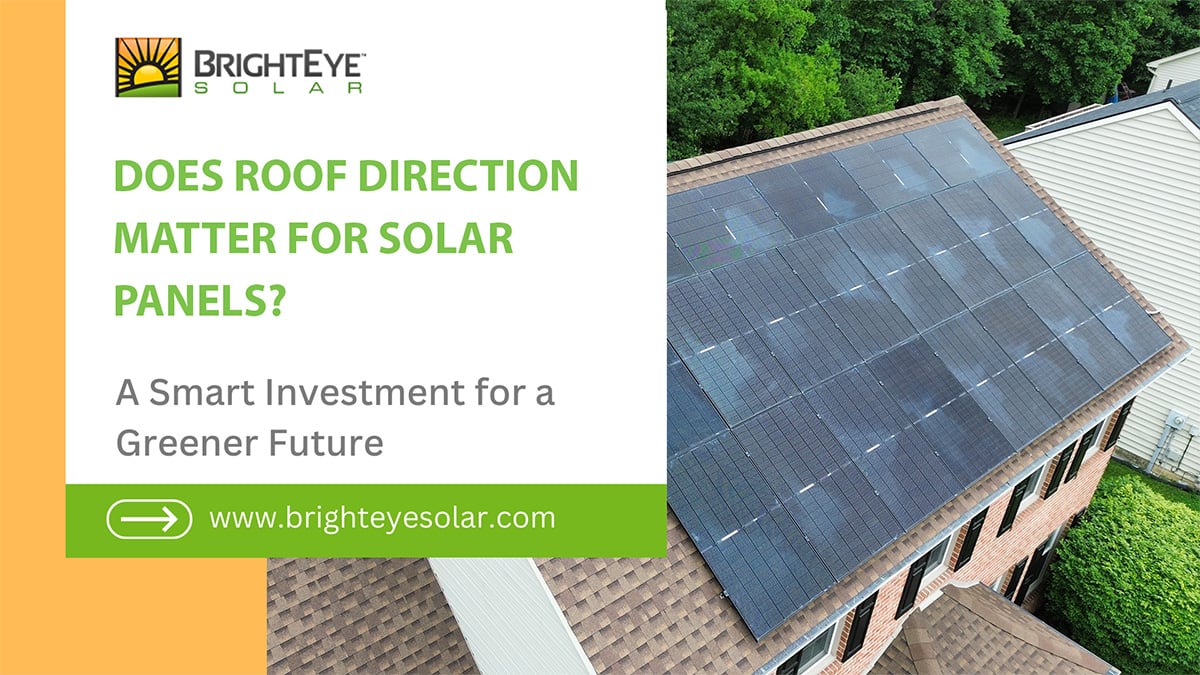
Does Your Roof Have to Face South to Get Solar Panels?
If you're thinking about installing solar panels on your home, you may have heard that a south-facing roof is best for solar energy production. And there is some truth to that. In the Northern Hemisphere, south-facing solar panels generally receive more direct sunlight throughout the day, making them the best option for solar production. But what if your roof faces east or west? Does that mean solar isn't a good option for your home? Not at all.
Many homes with east-facing and west-facing roofs can still produce plenty of electricity with solar panels. In fact, the direction your roof faces is just one of several factors that determine how much energy your system can generate. Before ruling out solar, it's worth understanding how roof orientation affects production and what options may be available for your home.
1. How Does Roof Direction Affect Solar Panel Production?
Solar panels generate electricity when sunlight reaches their surface. The amount of electricity they produce depends on several factors, including sunlight exposure, panel orientation, roof angle, shading, and weather conditions. In Pennsylvania and the mid-atlantic, south-facing solar panels generally offer the greatest overall production potential because they receive strong sunlight throughout the day. However, east-facing and west-facing panels can also perform very well. Here's how each direction typically affects solar production.
South-Facing Roofs
South-facing roofs are often considered ideal for solar panels. They receive the most sunlight throughout the day, allowing solar panels to generate electricity during both morning and afternoon hours. This orientation can help maximize annual electricity production when other conditions, such as roof pitch and shading, are also favorable.
East-Facing Roofs
East-facing solar panels receive more direct sunlight during the morning. They begin generating electricity earlier in the day and typically produce their highest output during the morning hours. This can be beneficial for households that use more electricity early in the day, such as families running appliances, preparing breakfast, or getting ready for work and school. While east-facing panels may produce less electricity over the entire year than comparable south-facing panels, they can still make a meaningful contribution to your home's energy needs.
West-Facing Roofs
West-facing solar panels receive more direct sunlight during the afternoon and early evening. Their production typically increases later in the day, making them a good option for households that use more electricity after work or school. Some households may use more electricity in the afternoon and evening when they return home, cook dinner, run appliances, and use air conditioning. West-facing panels may also help produce electricity during hours when household energy demand is higher. The important thing to remember is that more annual production isn't the only factor worth considering. The timing of solar production can also matter.
2. Can East-Facing and West-Facing Solar Panels Still Save You Money?
Even if your roof doesn't face south, solar panels can still help reduce your electricity costs.
The amount you can save depends on several factors:
- How much electricity your household uses.
- The number of solar panels that can fit on your roof.
- The direction and angle of your roof.
- How much shade your roof receives.
- The efficiency of the solar panels.
- Your local electricity rates and utility's net metering policies.
For example, imagine two homeowners with similar electricity usage:
One has a south-facing roof, while the other has a west-facing roof. The south-facing system may produce more electricity over the course of a year. However, the west-facing system may generate a larger portion of its electricity later in the day, when that homeowner uses more power.
Depending on the home's electricity usage and utility compensation rules, the difference in financial savings may be smaller than the difference in total electricity production. That's why it's important to evaluate more than just roof direction when determining whether solar makes financial sense.
3. What If Your Roof Faces Both East and West?
Here's something many homeowners don't realize: You may not have to choose just one side of your roof.
If your home has both east-facing and west-facing roof sections, a solar installer may be able to install panels on both sides. This approach can help spread electricity production throughout the day.
East-facing panels generate more electricity in the morning, while west-facing panels generate more in the afternoon. Together, they can create more production output. Depending on your home's layout, this may allow you to install a larger system than you could fit on one side of the roof alone. An installer can evaluate both roof sections to determine how many panels make sense and how much electricity the system would generate.
4. What Other Factors Matter Besides Roof Direction?
Roof orientation is important, but it isn't the only thing that determines whether your home is a good candidate for solar. Several other factors can have a significant impact on system performance.
Roof Pitch
The angle of your roof affects how directly sunlight reaches your solar panels. Some roof angles are better suited for solar production than others, but many different roof pitches can accommodate solar panels.
Shade From Trees and Nearby Buildings
Trees, chimneys, neighboring homes, and other obstructions can block sunlight and reduce solar production. Even a roof with an ideal south-facing orientation may not perform well if large trees shade it for much of the day.
Available Roof Space
The amount of usable roof space determines how many panels can be installed. Your installer will need to consider roof dimensions, obstructions, setbacks, and applicable installation requirements when designing your system.
Roof Age and Condition
Before installing solar, it's important to evaluate the condition of your roof. If your roof needs replacement soon, it may make sense to address that work before installing panels. Solar systems are long-term investments, so you want to make sure your roof is in good condition before installation begins.
Your Household's Electricity Usage
Your energy consumption is another important part of the equation. A good solar design should consider how much electricity you use and when you use it. This helps determine the appropriate system size and whether an east-facing, west-facing, or combination layout makes the most sense.
Conclusion
Homeowners in the Mid-Atlantic can absolutely benefit from solar panels on east-facing and west-facing roofs. While south-facing roofs generally offer the greatest production potential, east-west systems can still generate substantial electricity throughout the year. The best option depends on your specific property. An experienced solar installer will evaluate your roof direction, pitch, shading, available space, and electricity usage to estimate how much energy your system could produce. It's also important to consider your utility's policies for net metering and excess electricity. These policies can affect the financial value of electricity your system sends back to the grid.
The bottom line? Don't assume your home isn't suitable for solar just because your roof doesn't face south.
How Bright Eye Solar Can Help Determine If Your Roof Is Right for Solar
At Bright Eye Solar, we understand that every home is different. That's why we don't believe in recommending the same solar panel system for every homeowner. Our team evaluates your home's roof layout, orientation, shading, electricity usage, and other important factors to help determine what type of solar installation makes the most sense.
With more than 15 years of experience serving Pennsylvania, Maryland and New Jersey homeowners, we understand the local conditions and utility requirements that can affect residential solar installations. Whether your roof faces south, east, west, or a combination of directions, it's worth having your home evaluated before deciding that solar isn't an option.