
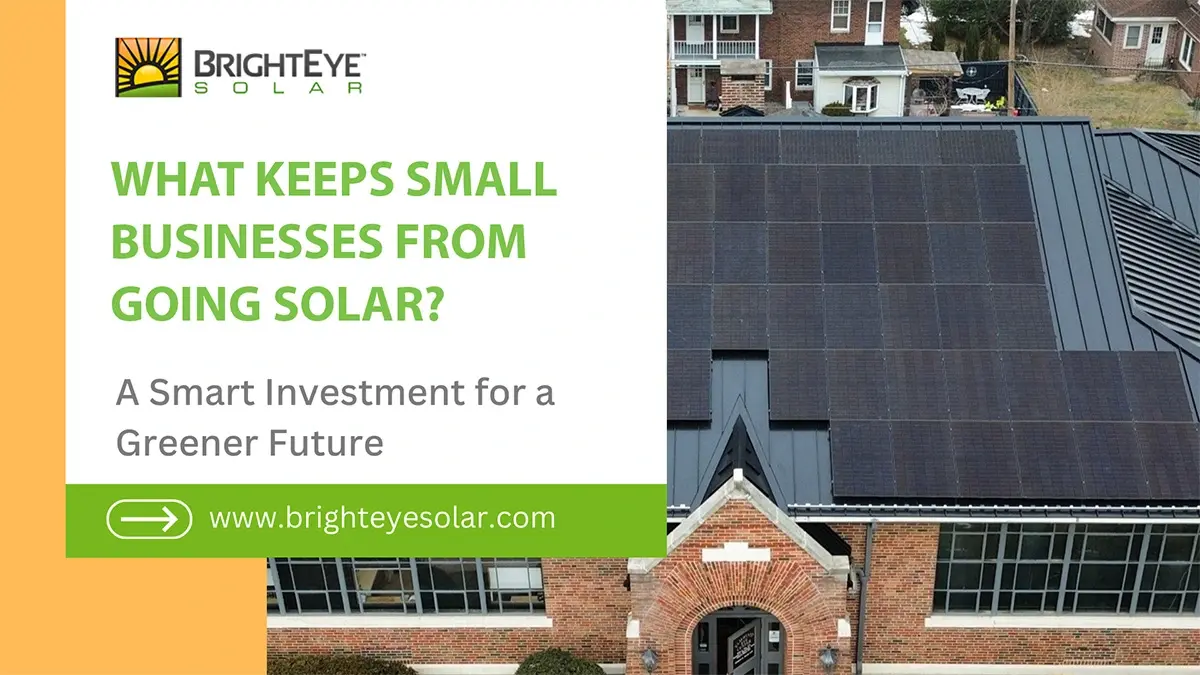
For small business owners weighing their next capital investment, rising electricity rates represent one of the fastest-growing line items on the operating budget. Commercial solar panel installation has become one of the smartest, most impactful investments an organization can make.
Solar locks in predictable energy costs and protects long-term cash flow. Yet many small commercial operations still delay the switch. Concerns about upfront costs, financing complexity, and roof suitability keep the decision on hold. Below, we break down the real barriers to small business solar adoption and how financing, incentives, and turnkey installation services change the equation.
Key Takeaways: What Keeps Small Businesses From Going Solar?
- High upfront costs are the primary reason small businesses delay solar adoption, but multiple financing paths now remove that obstacle. WhUSDA REAP grants and net metering credits reduce commercial solar project costs significantly. Bright Eye Solar offers turnkey commercial installations with flexible financing, free consultations, and full permitting support. Roof condition, structural readiness, and limited space can be addressed through ground-mounted systems and professional site assessments. Locking in energy costs today protects your business from future utility rate increases and improves long-term financial stability.
Why Do Small Businesses Hesitate to Invest in Commercial Solar?
Small business owners operate on tight margins. When a capital project requires significant upfront spending, the decision naturally gets pushed to next quarter, then next year. For commercial solar, the perceived cost barrier is often larger than the actual one.
The initial investment for a small commercial solar system can range widely depending on system size, roof configuration, and local permitting requirements. Many owners assume they need to pay the full amount out of pocket. That assumption is outdated.
Other hesitations include uncertainty about roof suitability, payback timelines, and whether the business will stay at the same location long enough to recoup the investment. Each concern has a practical answer once the right solar planning process is in place.
How Does Commercial Solar Financing Remove the Cost Barrier?
Financing has changed the commercial solar equation more than any other factor over the past decade. Today, organizations can choose from several pathways:
- Cash purchase: Full ownership with maximum long-term return and all available tax benefits.
- Solar loans: Spread payments over time while retaining ownership and incentive eligibility.
- Power Purchase Agreements (PPAs): A third party owns the system, and your business purchases energy at a fixed, predictable rate with no upfront capital required.
- Equipment leases: Low-commitment entry into solar with flexible terms.
This flexibility helps businesses of all sizes find a structure that fits their cash flow. Whether your priority is maximizing ROI through ownership or minimizing risk through a PPA, commercial solar financing options match your situation.
Bright Eye Solar walks business owners through each option during a free consultation, helping you select the model that aligns with your budget and long-term plans.
What Federal and State Incentives Lower Commercial Solar Costs?
State incentives and grant programs play a major role in making commercial solar accessible for small businesses. The USDA Rural Energy for America Program (REAP) offers grants that can cover up to 50% of total eligible project costs for rural small businesses and agricultural producers.
According to the NC Clean Energy Technology Center (2025), REAP has helped rural operations implement renewable energy systems for over two decades. Bright Eye Solar has expertise in qualifying businesses for REAP grants and guiding them through the application process.
State-level programs, including Solar Renewable Energy Credits (SRECs) and local rebate initiatives, add another layer of financial relief. Combined, these incentives shorten payback periods and accelerate the path to positive cash flow.
How Does Net Metering Improve the Solar Business Case?
Net metering (where available) allows businesses to earn credits for excess power their solar system sends back to the grid. During peak production hours, your panels may generate more electricity than your building consumes. Those surplus kilowatt-hours become credits on your utility bill, offsetting electricity drawn during evenings or cloudy periods.
For small businesses with variable energy demand, net metering creates a financial cushion that smooths out monthly costs. The result is greater budget predictability. You can learn more about how this works in Bright Eye Solar's net metering guide.
What If Your Roof Cannot Support Solar Panels?
Roof condition is a real concern for older commercial buildings. Structural integrity, available square footage, shading from adjacent structures, and roof orientation all influence whether rooftop panels are feasible. A professional site assessment identifies these factors early so there are no surprises after the project begins.
When a rooftop installation is not ideal, ground-mounted solar systems offer an effective alternative. Ground arrays can be positioned for optimal sun exposure without the constraints of existing roof geometry.
Bright Eye Solar conducts property evaluations that cover structural readiness, shading analysis, and mounting options to determine the right configuration for your building.
How Long Does It Take for Commercial Solar to Pay for Itself?
Payback periods for small commercial solar systems depend on energy consumption, system size, local utility rates, and the incentives applied to the project. With state-level credits factored in, many businesses see their solar investment recover in a few years.
After the payback point, the energy your system produces is essentially free. Solar panels typically perform for 25 years or more, which means decades of reduced operating expenses after the initial cost is recovered.
High-energy-use industries like manufacturing, retail, warehousing, and agriculture often see the fastest financial benefits.
Bright Eye Solar uses your historical utility data to model expected production and savings, giving you a clear projection based on your actual energy usage rather than generic estimates.
How Does Going Solar Strengthen Your Business Long Term?
Beyond monthly bill reduction, commercial solar installation delivers financial stability that compounds over time. Solar locks in predictable energy costs for the lifespan of the system, insulating your business from the rate increases that erode margins year after year.
Commercial properties with owned solar systems also tend to command higher market values. Buyers and tenants recognize the long-term savings and energy independence that solar panels deliver, making your property a more attractive asset.
Today's consumers, employees, and investors care about sustainability. A visible commitment to environmental leadership strengthens your brand reputation and can attract eco-conscious customers and talent.
Bright Eye Solar installs high-quality monocrystalline panels with 25+ year performance warranties, backed by ongoing monitoring through the Enphase Home Energy Solution for reliable, long-term system performance.
In Conclusion: How Financing Changes the Solar Equation for Small Businesses
Between the federal tax credit, state incentive programs, REAP grant opportunities, and flexible financing models, there has never been a better time for small businesses to invest in commercial solar.
The barriers that once kept organizations on the sideline have practical solutions. The long-term financial case has only grown stronger as utility rates continue to climb.
Commercial solar panel installation can help your business:
- - Lower operating expenses and improve cash flow
- - Increase energy independence from the grid
- - Strengthen long-term financial stability
- - Demonstrate environmental leadership to customers and stakeholders
If your organization is considering commercial solar, now is the perfect time to explore your options and calculate the long-term savings. Bright Eye Solar offers free consultations and estimates for businesses across Pennsylvania, Maryland, and New Jersey.
FAQs About Small Business Solar Adoption and Financing
What is the biggest barrier to small business solar adoption?
The perceived high upfront cost is the most common barrier. Modern financing options like solar loans, PPAs, and equipment leases remove the need for large capital outlays. Bright Eye Solar offers flexible payment structures that allow businesses to go solar with little to no money down.
Can a small business go solar with no upfront cost?
Yes. Power Purchase Agreements (PPAs) and certain lease structures allow businesses to install solar with zero upfront investment. The third-party owner maintains the system, and your business pays a fixed rate for the energy produced. Bright Eye Solar helps you evaluate which financing option matches your goals.
How do USDA REAP grants help small businesses afford solar?
REAP grants can cover up to 50% of eligible project costs for qualifying rural businesses and agricultural producers. Bright Eye Solar has a strong track record helping businesses navigate the REAP application process and identify whether their location qualifies for this program.
Is commercial solar worth it for businesses with low electricity bills?
If your current electricity costs are low, the payback period for solar may be longer. However, rising utility rates mean those bills are unlikely to stay low. Locking in solar energy costs now protects your business from future rate increases. Bright Eye Solar models your projected savings based on your actual energy usage and local rate trends.